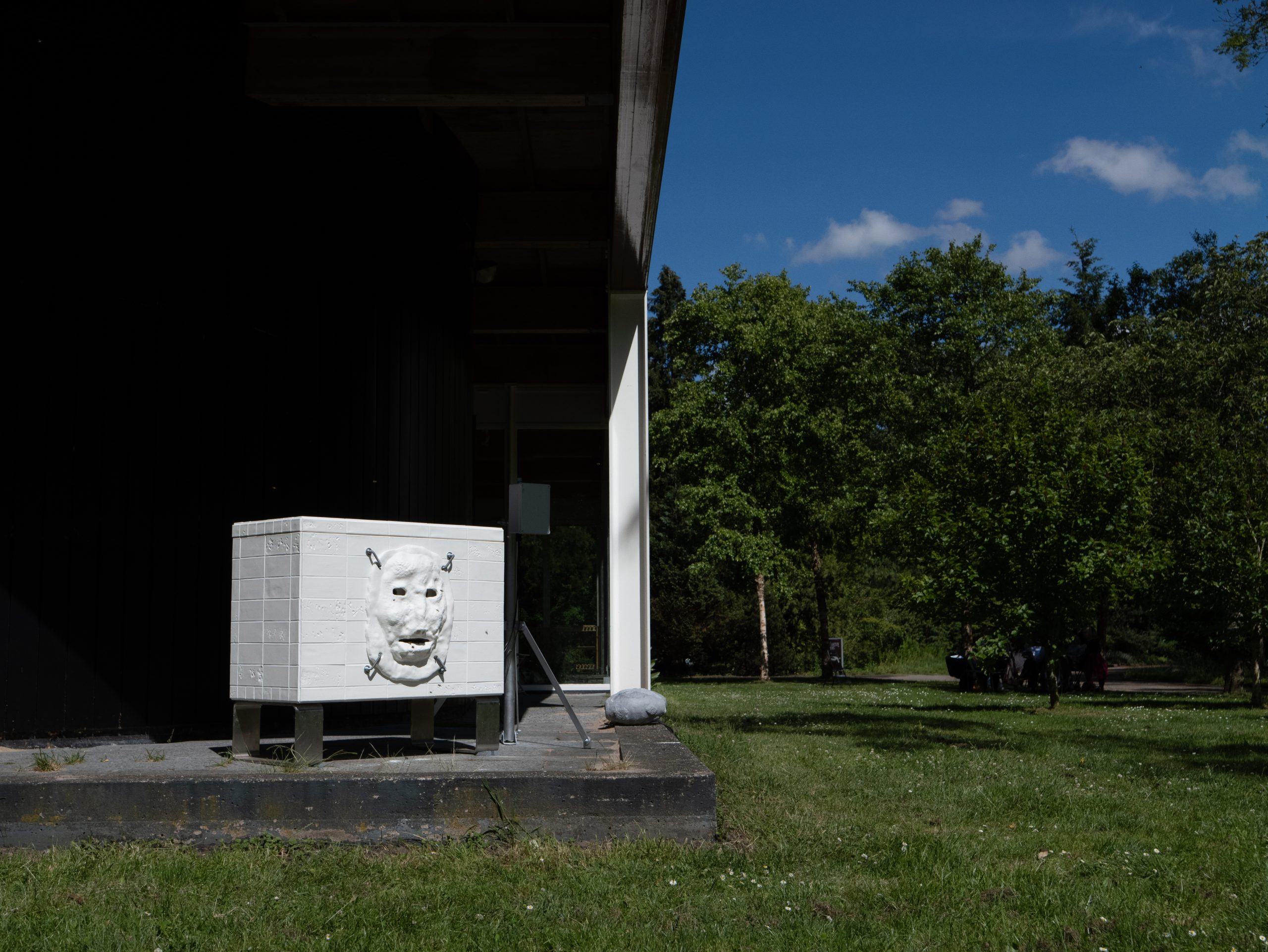
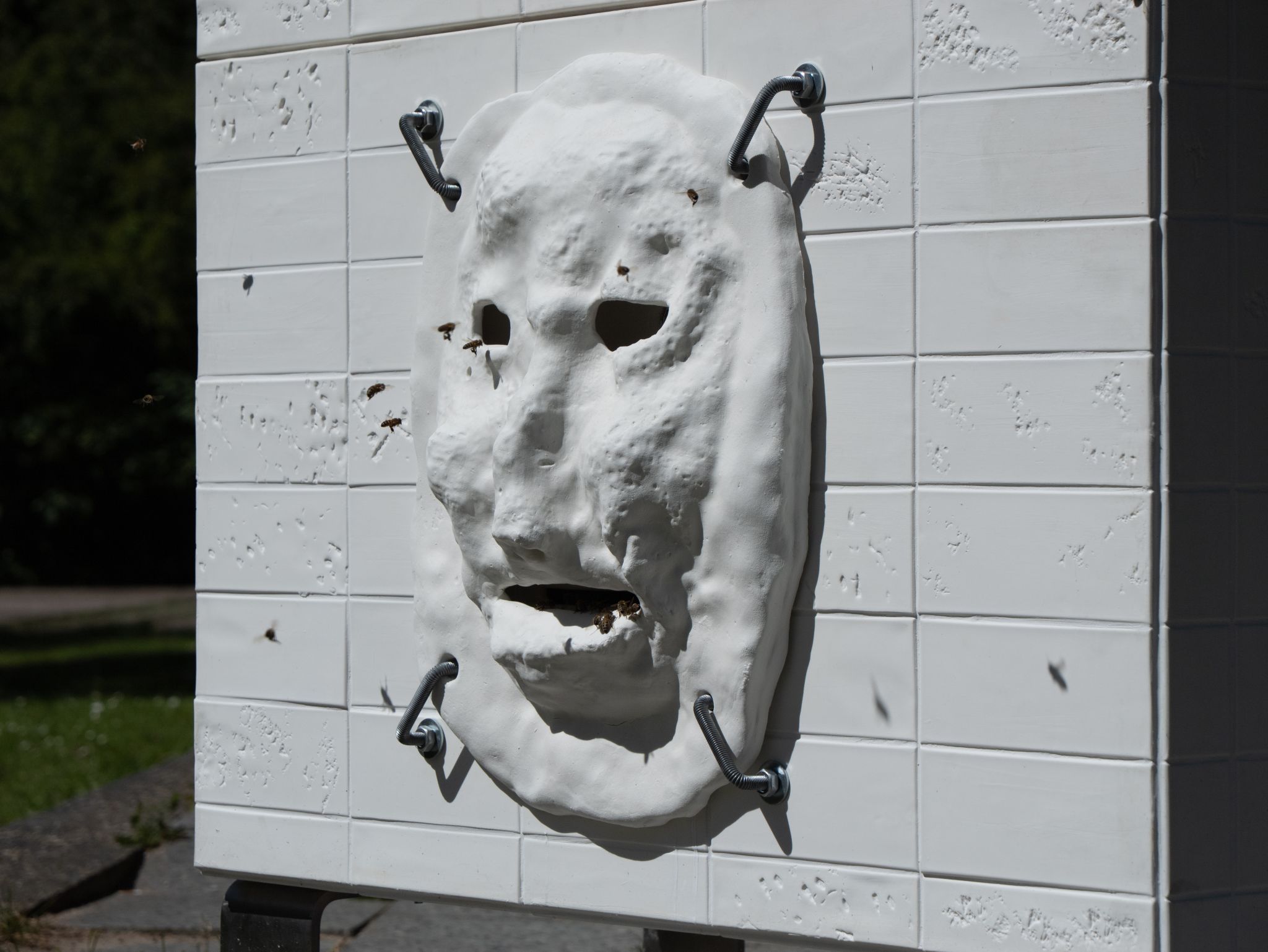
A porcelain sculpture behind the Glazen Huis houses a living colony of honeybees. Inside a work by the Dutch artist Hans de Vries is conserved within a sealed archival cabinet. Sensors in the beehive register its temperature and humidity, along with the electrostatic communication between the honeybees. These readings shift the light and atmosphere inside the cabinet. The decay and the legibility of the work are governed by the behaviour of the bees.
Whilst the architecture of the archive preserves an artefact by counteracting decay and transformation, a bee colony preserves itself precisely through constant change: a worker bee lives for a few weeks, but the colony endures for years. Every cell in the colony dies and is continuously replaced. Two forms of conservation are thus set against one another. Is sustainability about resisting change, or rather the ability to constantly transform and adapt?
The conserved work is a project by Hans de Vries, who is known as the archivist of the unnoticed unnoticeable. De Vries studied and recorded the processes of the natural world and was a close observer of the relationship between people and their environment. Throughout the exhibition, the work stands as an unfolding process. A score played out by the colony, the archive, the ecology of Amstelpark, and the beekeepers who mediate among them.
Credits
Technische Ondersteuning Joost Plattel & Jelle Reith; productie assistentie Ada Harpole; opbouw assistantie Imko Verhoef; woodworking Mette Veldhuis; bijenexpert Thomas Freitag; imkers Paula Bergasa Suso, Veronika Pukaová, Vanessa Krystek, Jessica Aliaga het Europees Keramisch Werkcentrum (EKWC).
Support van AFK, Mondriaan Fund, Stichting Stokroos, het Cultuurfonds

Behind the Glass House
Locations
Het Glazen Huis (exhibitions)
Rietveld Paviljoen (office)
Orangerie (Park Studio)
Exhibitions are open on Friday–Sunday,
1pm-5pm and by appointment.
Outdoor works are accessible daily.
Address
Het Glazen Huis
Amstelpark 7
1083 HZ Amsterdam
info@zone2source.net


